IUP Computer Science
COSC 110 Spring
2006
Project #2
High Wire Safety
(Due 15 Feb 06)
The Great Volare is developing a new high
wire act for the circus. The act uses two wires. One wire is
stretched taunt between two poles (the primaries) that are 80 feet apart
at a height of 40 feet above the ground. The other wire will be hung
loosely from two poles (the secondaries) that are right next to the primaries.
Volare intends to walk out to the center of the taunt wire and then transfer
to the loose wire to do his act. In order for the roustabouts to
set up the poles and to make sure the rigging is safe, several calculations
need to be made based on Volare's weight and the maximum amount
of sag which is to be allowed in the taunt wire.
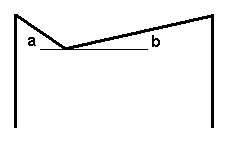
The first calculation is for the tension
which Volare's weight will put on the primary poles at the "quarter point".
The quarter point is 1/4 of the way across the wire, i.e., 20 feet from
the starting end. At this point, the wire will have half of the
sag that it will have when Volare reaches the middle. Here is
an exaggerated diagram of the taunt wire when Volare reaches this point.
Here, a is the angle at the quarter
point between the wire to the near pole and a horizontal line; and b
is the angle between the wire to the far pole and horizontal line.
It is then possible to calculate the tension on the two poles using the
following formulas. Tn is the tension in pounds on the
near pole and Tf is the tension on the far pole.
weight (cos b)
Tn (cos a)
Tn = ---------------------------------------------
Tf = ----------------
(cos b) (sin a) + (cos a) (sin b)
cos b
Note that the sin a is just half of
the total sag divided by 20 (the distance to the quarter point) and
the sin b is half the total sag divided by 60.
To be safe, Volare's weight and the maximum
sag must be such that the tension on each of the primary poles is less
than one ton (2000 pounds).
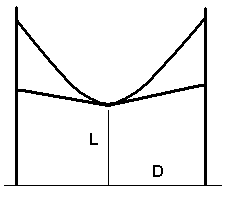
The second calculation is to determine
how to hang the loose wire so that it hangs level with the taunt wire when
Volare is at the center of the taunt wire (at the maximum sag point).
No added tension is to be put on the loose wire; it is to be hung as what
is known as a catenary. The calculation is to determine how high
on the secondary poles the loose wire is to be attached so that it hangs
properly. The formula is as follows
L ( e(D/L) + e(-D/L) )
SecondaryHeight = -----------------------------
2
where L is the distance from the ground
to the maximum sag point and D is the distance from the center of the wire
to a pole on either side. e is the base of natural logarithms.
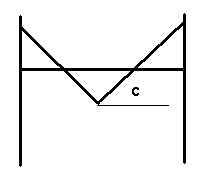
The last calculation is to determine the
tension on the secondary poles when Volare steps onto the loose wire.
The loose wire is expected to sag two more feet and become taunt
under Volare's weight. The tension on each of the two secondary poles
is the same, Ts ; calculate it using the formula.
weight
Ts = ---------------
2 (sin c)
You are to write a program that prompts
for Volare's weight and the maximum sag allowed in the taunt wire.
Then, using the formulas above, make the calculations of the tensions in
the primary poles at the quarter point, the height for the loose wire attachment
on the secondary poles and the tension on each secondary pole after Volare
has transferred to the loose wire. For example, if Volare weighs
200 pounds and the maximum sag is 2 feet, your program should produce the
following results.
At quarter point:
Tension on near pole
is 3000.83 pounds and tension on far pole is 2997.5 pounds.
Height of wire on secondary
pole must be 61.0698 feet.
Tension on each secondary
pole is 254.777 pounds.
Notice that these results would be unacceptable
because the tension on the primary poles is far too high. Two days
before the project is due, I will provide Volare's actual weight and the
true maximum sag allowed. You are to hand in a printout of your well
documented program and a screen capture of the output of your program when
you enter the values I give you later. You must also copy the .cpp
file to the handin folder on the P drive. Before copying, be sure
to name this file after yourself. For example, I would name mine
p2-wolfe.cpp