The Debugger Fall 1994
Table of Contents
EDITOR'S NOTES
In this issue, you will find several firsts. To begin with, Warren
Hilton provides our first original poem. Warren is currently finishing
an internship and shows that the experience has clearly had an effect
on him. Also, another intern, Aston Au Yeung, makes our first
contribution that is in the form of a response to a previous article.
Aston's article mostly stands on its own, even if you are not familiar
with Ed Moore's original article to which Aston refers. If you don't
pick up on the algorithm references, you may want to look back at the
Summer '94 issue. Ed contributes another article to this issue, again
bringing the perspective of the non-traditional student.
Another first is the inclusion of a trivia quiz. I am the one who
devised the questions for the quiz. I am told that I have a reputation
for giving "hard" examinations; I am not trying to
maintain that reputation with the trivia quiz. If you think the quiz is
too hard, too easy, too stupid, too silly, too unimportant, or too
anything-else, I would like to hear from you. My only purpose in
including the quiz is to jog your memories about something that you
probably once knew well.
In two of our regular features, "From the Chair" (which this time is
from the acting chair) and "Carol's Corner," you will read about Gary
Buterbaugh's very unfortunate experience last August. Although I have
seen Gary only infrequently this semester, he seems to be doing better.
Tia Watts and Bill Creighton provide the serious contributions to this
issue. Tia, who just returned from educational leave, discusses a topic
related to her research and one that will need to be addressed more
seriously in our curriculum in the future. Bill gives you a brief idea
of what it is like trying to accommodate a Middle States
reaccreditation evaluation - this self-assessment task is an enormous
undertaking.
Jim Wolfe, Editor
From the Acting Chair
Bill Oblitey
I am sure that you are very eager to read my column in this issue of The
Debugger. For those of you who may still not be aware of what
I am up to, I am, for this Fall semester, acting as chairperson of the
department. Oh yes, I know you are wondering whether I have taken any
courses in acting before. Well, you need not worry because Carol will
tell you what type of a show I put up. So far, what I can report is
that the show is still going on and I haven't heard anyone in the
audience booing yet - or maybe I am getting deaf.
Dr. Gary Buterbaugh opted to go on sabbatical and I was selected to put
up an act in his absence. However, he took a trip to Philadelphia and
unfortunately fell into bad company (in the person of a mugger). He got
his jaw broken and his company also took a few of his teeth. He went
into surgery and he was fixed up enough to get him to attend a wedding
- his reason for going to Philadelphia in the first place. When he
returned to Indiana, he had to go for a check up and the specialist
discovered that he had an infection and put him in surgery, again. Yes,
you said it, poor guy! So, suffice it to say that he was not in any
shape to embark on a sabbatical that was supposed to take him around
the world. He asked to take a sick leave and on his return from the
sick leave to help with the Admissions Department. He is currently with
that Department and he will return to his desk (the one I am currently
occupying) and the end of this semester. His sabbatical has been
postponed.
Now let me tell you what I have been doing this semester. First, I have
been acting as chairperson. That means watching Carol all day for four
days and then seeing her get agitated on Friday! Yes, she's still
working miracles. The chairmanship is quite interesting. I make great
plans and take them to faculty meetings only for them to be shattered -
what can be more fun? I am also teaching two sections of CO 380 and one
section of CO 480. Both are fun. Student presentations have been very
interesting. I have always had to restrain myself from joining in the
discussions that follow presentations. The questions that follow the
presentations are spontaneous. Everyone is eager to ask a question and
honestly, I don't think this is happening because I give points for
questions asked. No, the students are just eager to ask questions and
to challenge the speakers for the day.
I am also in charge of the internship program for this semester. We
have six candidates to place. Four are already placed, one each with
JCCEOA, PHICO, Prudential and Systems Automation. Two are still
interviewing. I have also had two visitations to Philadelphia,
Harrisburg and Pittsburgh, so far. The first visitations were with Dr.
Buterbaugh when he introduced me to the supervisors at the various
sites for me to take over from him for the semester. The second
visitations were interesting. I made a few wrong turns and crossed a
few wrong bridges and poor Aston Au Yeung was wondering if I would ever
show up at his site. I will be leaving for Pittsburgh again, this
Monday, for my final visit. I will be in Philadelphia and Harrisburg on
Friday. Already I have had a
call from Aston who wants to be sure that I do not make a wrong turn
and thus will meet with him on time. I told him not to worry but I
think that rather got him concerned.
With funding from DuPont, the Department under Gary's leadership
purchased four Dell 486 machines equipped with DOS 6.2, Windows 3.1,
Microsoft Office and Turbo Pascal 5.0 to donate to churches that have
lots of minority youth. This is part of our recruitment efforts
directed at minority students. The Philadelphia churches that were
selected to benefit from the computer donations are the Mount Airy
Church of God in Christ and the Sharon Baptist Church. The Pittsburgh
churches are the Rodman Street Missionary Baptist Church and the Bethel
A. M. E. Church. On November 7, Gary and I were in Philadelphia to
donate the computers to representatives from Sharon Baptist and Mount
Airy churches in the presence of representatives from DuPont. Gary gave
me a tour of Philadelphia. He even took me to the site where he was
mugged, don't worry, we were in his car and couldn't be attacked. In a
few weeks time he and I plan to go to Pittsburgh to donate the
remaining two computers to the Pittsburgh churches.
Carol's Corner
Carol Miller
Hi All -
It's That Time of the Season, Again, Folks - Debugger Season! But, it's
also a beautiful season here in Indiana for a change. The weather has
been more than we could possibly ask for. I don't remember having a
Fall like this for many, many years - if ever. I hope it doesn't mean
we're going to get a late, nasty winter that lasts until June. Some way
we seem to get through them though, don't we?
Hope you had a nice Halloween and didn't scare too many people. I don't
think I did, but I had trouble removing my mask. I tried for three days
until someone finally told me I wasn't wearing one. One of the
disadvantages of aging, I guess.
The Maple's are still globe trotting, they've been to New York several
times this summer and fall and they were down South for a couple weeks
this summer. I don't know about you guys, but that sounds like the life
I'd like to be leading. I know they are really enjoying it.
Tia Watts is back among us teaching this semester. She looks like she's
really loving it, and I'm sure she is. Who wouldn't be happy to back
with this group?
Gary Buterbaugh was to be on sabbatical this semester; but, as you may
have heard, he was mugged in Philadelphia in August. He had his jaw
broken and lost some teeth. He had plates inserted in his jaw in
Philadelphia and still planned on his trip around the world. But, when
he saw a doctor here in Indiana, he discovered he had an infection in
the bone and admitted him to the hospital here in Indiana and removed
some of the bone and inserted another plate. Since the doctor wasn't
sure when the infection would clear, Gary decided to cancel his trip.
So, he is working in the Admissions until the end of the semester and
is going to take his sabbatical another time. Anyway, his globetrotting
for this semester has been limited to across campus. He stops in every
once in awhile.
I haven't received a lot of news from you, though, so this will be a
short column. Here goes:
Mark (5/85) and Bev (Green) (5/85) Landry
were in a bad accident Memorial Day weekend on Interstate 80 here in
PA. Both were hurt, but Bev (as of August) was still not back to work.
She had some leg injuries and wasn't walking much yet. She was having
physical therapy and hoping to be back to work soon after we talked
with her. Bev, hope by now you're doing better. Mark, hope you're
feeling better, too. Give us an update!
Michelle Hart (5/91), who hasn't even bothered to
tell me personally, is no longer working for Latrobe Steel. She is now
working for Biocontrol here in Indiana. Mickie had been trying to get a
job closer to Indiana to save the commute and so her children could
stay in the Indiana Schools. Congratulations, Mickie!!
I saw Janie (Pike) Kustaborder (5/92) and her
husband, Ron, at the wedding of Chris Britt in
September. In case some of you remember, Chris worked here in the
office for a year or so. Janie and Ron almost have their house
remodeled, but Janie has been working 60 and 70 hour weeks at HRB
Systems, so I guess it might be a little while. We had a good time at
the wedding and it's always nice to see you two.
And, speaking of HRB Systems, in the last issue I told you Lisa
Dillon (12/93) was working at Mellon on a temporary project.
Well, since that time, Lisa was hired at HRB Systems and has moved into
an A-frame in the State College area. Since Lisa has 2 dogs, 6 cats,
and 2 guinea pigs, as well as fish and ducks, an apartment in the city
wouldn't work. Last I talked with her, she loves it up there.
In addition to Janie and Lisa, Tony Boslett (5/92)
and Mark McBride (5/80) are two more of our bunch
at HRB Systems in State College.
J.C. Caler (5/90) called me the other day (from her
cellular phone, no less). J.C. is still working for Hercules, Inc. as a
contract programmer. Right now she is working at Thrift Drug
(Pittsburgh) and has moved to McKeesport. Thanks for the update, J.C.
We had a nice letter from Bonnie Krensavage (5/88)
with a really nice update on her life since IUP. Bonnie went with
DuPont when she graduated. She was in technical support in Delaware,
then technical marketing. Then, she transferred to Asheville, NC where
she automated a start-up business. While in Asheville, she met her
husband who was a DuPont engineer in Delaware; so she transferred back
to Delaware. They got
married in '92; and Bonnie programmed and managed small projects for
two years in Delaware for DuPont. Then they both decided to move on and
landed jobs in MI. Bonnie is now working for Whirlpool Financial as a
customer liaison and project manager, and her husband (Steve Smith) is
working for Digital Interface Systems. They are about 2 hours for
Chicago and are looking for alumni in the area. Anybody out there?
Sounds to me like Bonnie is not only enjoying being married, but is
also just plain enjoying life (although she did mention that her
husband was reading over her shoulder).
Peggy Mogush (5/87) wrote to say how much she
enjoyed the last issue with the pictures and reminisced about the good
ole days with Data Communications class with WWO where she and Mike
Gutzat couldn't stay awake - anybody else there? Peggy mentioned how
nice it would be to get an IUP gopher service. Actually, Peggy has
looked into it and found that one is under construction, so look
forward to the next issues and see what's happening. Thanks for info,
Peggy and please keep it coming.
And, speaking of Mike Gutzat (5/87), he and Mary
are planning a holiday at home this year. Since Ryan will be
celebrating his first Christmas, they want to be home, so all their
friends could come visit. Do you have room for all of us, Mike
& Mary?
We had an update on Eduardo Morales (5/91) .
Eduardo was admitted to the Ph.D. program at NJIT and was given a
teaching assistantship and is teaching computer programming and problem
solving. Keep us posted.
I had e-mail from John Campos (8/91) right before
Homecoming and I owe you an apology, John. I tried to e-mail you back
and it kept being returned. That wasn't bad enough, but it was returned
a week after I sent it. I tried several methods and nothing would go
through. I wanted to tell you that I called around Indiana and the
surrounding areas to see if there were any vacancies for Homecoming,
but I didn't find anything, so my news was no news, but I'm really
sorry it didn't make it to you.
Well, I told you in the last edition that Mike Elder (5/94)
was getting married in October, and he did, October 1. Congratulations
to Mike and Lori. They went on a cruise of the islands for their
honeymoon and had a great time. Hi Mikey!!
And, speaking of weddings, I also told you in the last edition that Tonya
Jeschonek (5/92) and Jen Baldwin (5/91) had banned me from
printing anything about them. Well, Jen lifted her ban. She recently
attended an Oracle convention in San Francisco, but was too busy to
enjoy the sites. Jen is also getting married in November. Send me
further details, Jen. She is still in Allentown with Pennsylvania Power
& Light. Jen has cats, too, I think three of them, right?
Bill Smith (12/93) has been kind enough to keep in
touch often. Thanks, Bill. Bill is still at Mellon and is still with
Michelle. They are looking for a place out of Pittsburgh and the rat
race. Being a country boy does that to you, Bill. I can appreciate it.
Keep in touch.
Jeff Michna (12/93) keeps in touch, too. He's still
is Jackson, Mississippi with AMS and still loves his job. Jeff is also
traveling all over the place - like the islands and Europe and out West
(not for his job - for fun!). On top of all that, he still has time to
come home to Homer City often. Hi Jeff!!
Eric Zeglen (5/92) stopped in a couple times when
he was in the building. If you remember, Eric is now working for IUP in
the library. They are in the process of multimediating(?) the library.
Eric got to see my new hat. If you guys be good and are lucky, maybe
we'll put a picture in The Debugger and you can see
it, too.
T.J. Hall (5/88) not only sent e-mail, but called one day.
T.J. is still at Weirton Steel. And, he and Patty still live in
Pittsburgh. He brought me up to date on his life and also the lives of
some others. For instance, Linda Kielarowski (5/88)
is no longer at Mellon Bank in Pittsburgh. She's on the eastern part of
the state now. Hey, Linda, how about an update. Also, Anita
(Costa) Louttit (5/88) is no longer working at Westinghouse.
Where are you?? And, it seems Beth (Blum) Potter (5/88)
has some information for me, too, don't you Beth? I owe T.J. an
apology. I thought I wrote about him lots in The Debugger,
but he told me I had only mentioned him one other time. I'm really
sorry T.J., cause you do keep in touch constantly.
When Jesse Maxwell (12/90) graduated, he
went to Latrobe Steel (I think he did an internship there, am I right,
Jesse?. I had heard he was no longer with Latrobe Stell, but I didn't
know where he was. Well, now I know. Jesse sent me an update. After
Latrobe Steel he moved to Columbus, Ohio and worked for Chemical
Mortgage Company (I heard drugs were costly, but I didn't know you had
to get a mortgage to pay for them or do I have the wrong chemicals?)
for three years. Now, guys, I don't want you to drool onto your shirts,
so go get a Kleenex or something - Jesse is now employed with
Victoria's Secret Catalogue. He didn't give me too many details -
wonder why - but he did tell me something I hadn't known, Victoria's
Secret is a division of the Limited. So, I guess that's Victoria's
Secret. Jesse Maxwell and Victoria's Secret, somehow it just fits.
Anyway Jesse, thanks for the news.
Brian Lawton (5/93) and Mindi stopped in on 11/4. We also had
lunch in September. Brian loves his work with System Automation.. I
think I mentioned last time that System Automation opened a new
division called Client Servers and Brian is a Power Builder. He just
finished working with MCI, now he is going to be working with the
Bureau of Cultural Affairs with US Information Agencies. Briana and
Kevin were along. Kevin was born August 17, he weighed 7 lbs. 11 oz and
was 20 1/4 inches long. And, he is adorable. He's 2 1/2 months old and
doesn't look anything like Briana. Bri is still
just as cute and sweet as ever. I don't think that will ever change.
Andy Weiss (5/93) sent me a nice letter. He is still working
for Cornerstone Software in Morgantown, PA and absolutely loves his
job. In case I hadn't mentioned before, Cornerstone writes software
that keeps track of tractor trailer rigs across the US. He went
to the wedding of Stacey Hinkle (5/92) to Randy
Wilkinson who was a math major. They got married on September
17 in Harrisburg. Stacey is working for a company that makes leaf
springs for automobiles. She's coding RPG on an AS/400. Randy is coding
COBOL for Blue Shield. Stacey has been in touch with Gary
Perrier (5/93). Gary is doing well, but just changed jobs to
one he likes much better (I don't know where). Andy also is in touch
with Dave Campbell (5/91) who is working, not in
the computer field but loves his work. Thanks for all the news, Andy,
and thanks for keeping in touch.
Ruvi Wijesuriya (8/93) sent me email. It was so nice
to hear from you, Ruvi. Ruvi is working on a master of education degree
in educational Media and Computers at the University of Arizona in
Tempe. It a program that entails design and production of computer
based instruction software with a lot of multimedia work, and
animation. Ruvi, as usual, seems to be enjoying life and with
temperatures in the 70's right now you can see why. Keep in touch, Ruvi!
Drew Senko (5/89) checked in to say hello and
e-mailed me a picture of his convertible. You've heard of cars being
held together with chewing gum and spit, well, Drew's car is a
combination of dashes, dots, slashes and equal signs. Or, at least
that's what it looked like. Actually, it's a '71 Olds Cutlass
Convertible that he drives in sunny weather. I enjoyed it, Drew!
Sean Sell 5/94) called a
couple times. Sean is back from the south and working for NIST in
Gaithersburg MD and likes his work there. Keep in touch. Sean
Nilan Fernando (5/94) also sent me e-mail. Nilan is
working on his graduate application work, studying for his GRE's and
doing some work at Palm Beach Atlantic College in West Palm Beach.
I had an idea - see what you
think.. Do you ever wonder where somebody is and what they are doing or
am I the only one? I was thinking that it might be interesting to have
you give me the names of your classmates that you might be wondering
about. I'll put the names in my column and ask them to let us know
where they are and what they are doing Like, for instance, I've been
wondering about Jeanne Peoples (5/85) and Janet
Harrell (5/90). Do you think that's a good idea or what? Let
me know!
I think that's all the news that's fit to print for this time. Hope you
all have a great Holiday Season and you get to spend time with your
families.
Til next time ---
News from Tompkins' Lab
Don Rosenberger
Once again, Jim Wolfe reminds me that it is time for an article for The
Debugger. Unfortunately, we haven't done any recent lab
upgrades, so I cannot rely on lab news to fill my space. Therefore, I
decided to talk about the Computer EXPO that was held in Pittsburgh on
October 27.
The EXPO included three hundred vendors. It was quite an exercise to
see everything, but well worth the trip. Many demonstrations were
conducted, for both new products and beta versions. I was interested in
looking at products which could benefit our students, and have come to
conclusions in three areas.
First, while several furniture vendors attended the EXPO, they have not
trained their personnel for planning the "modern" facilities. That is,
the sales representatives can speak at length about "workstation
ergonomics", but are not at all familiar with the requirements set
forth by the Americans with Disabilities Act (ADA). The ADA was passed
in 1990 as a set of guidelines to insure that facilities would be
accessible to the handicapped. As a disabled veteran, and an officer in
the IUP Advocates for DisABLED Students, I tend to look at this issue
very seriously. Those of you who will plan laboratory facilities should
gain an understanding of the ADA. To quote an old seat belt commercial,
"It's not just a good idea. It's the law!"
The least impressive product at the EXPO turned out to be Windows '95.
A beta version was supposed to be demonstrated, but did not appear. I
did not see any handouts for the application, and Microsoft reps.
seemed to be engrossed in demonstrating everything else in their
product line. I overheard that the proposed delivery date had slipped
yet again, giving the impression that Windows '96 is becoming a
potential new name.
The most impressive product I saw at the EXPO was OS/2 version 3, also
called WARP. This demonstration was of the actual product, which is
available for sale today. It had many of the intrinsic "networking"
functions available, and performed tasks that I have never seen Windows
attempt. It does all of this in 4MB of RAM, and a "full" installation
takes less than eighty MB of hard disk space. This is an improvement
over earlier OS/2 versions, and requires less resources than the new
Windows version is supposed to require. In many areas, IBM is giving
away OS/2, version 2.1, in the CD ROM version to students and faculty.
The package includes a discount coupon for version 3, which is a great
enticement for people to try OS/2. Therefore, IBM has let their
competition know that the battle has begun. I would like to get a copy
(or more) of OS/2 working in the lab, so that our faculty/students can
take a serious look at the product. I will let our readers know later
if we are able to accomplish this.
By the way, our Beginning VAX Users Manual was just updated and
released. If you know anyone who could use more documentation about the
VMS mainframe, they might find our manual helpful. It is available
under the author-name "Tompkins Lab" at Copies Now and Pro Packets, and
costs about $3 per copy. (We take no royalties, this is the
reproduction cost only.)
Trivia Quiz
In response to a suggestion from an alumnus, we are including a short
IUP computer science trivia quiz? The questions are about computing at
IUP and the computer science department. Odds are that none of the
alumni can answer all of these questions - they apply to events that
happened at various times in the department's history. Nevertheless, we
hope you
give the quiz a try. No scoring system is given to evaluate yourself -
this is a fun quiz. Anyway, most of you are beyond the point where
scoring would be important (unless you are in graduate school). Answers
are provided on a later page. If you have any comments or suggestions
for the trivia quiz, direct them to Jim Wolfe or Carol Miller. We may
try to make this a regular feature of The Debugger.
1. Which computer science faculty member is known for developing a
railroad game?
2. What was the name of the operating system for the Honeywell computer
used at IUP for many years?
3. What was the model name of that Honeywell computer? (This one is a
bit tougher.)
4. Which computer science faculty member plays the most golf ? (or at
least claims to)
5. On what computer did students program in assembly language before we
had a VAX?
6. On what computer did assembly language students have to use paper
tape?
7. When did Carol become department secretary?
8. What faculty position did Kathy McKelvey hold at IUP prior to
becoming a member of the computer science faculty?
9. Back when the computer science department office was next to a
keypunch lab, in what building was the office?
10. Which computer science faculty member took classes at Penn State
with Charley Shubra?
The Dawn of A New Day
Warren Hilton
In the midst of confusion and chaos a child is born
A lovely child that if fed the proper love and care
Will grow as tall as the tallest mountain
An ambitious child that if provided the tools of determination and
courage
Will chisel away the cement of hate and discrimination
An intelligent child that if given the armor of education and knowledge
Will fend off the ignorance of society
Yes, In the midst of confusion and chaos a child is born
If you lay the path for his excellence
He will bring forth The Dawn of A New Day
The world is anxiously awaiting the dawn of a new day. Day in and day
out, I see a great many people planning for the dawn of a new day; a
day of technological dominance. Daily I notice the conversations about
'The Technology Age,' and I can not help but see that most people are
grasping at thin air. In other words, many people can talk the talk,
but in reality can not walk the walk. Within the measuring cup of
technology lies the key ingredient; INFORMATION. As computer science
enthusiasts, we live and breath data. In the halls of academics, I walk
along the path of information processing. On the other hand as a
professional, my life is not centered around information; however, my
key focus is people (and then the information that people want). As a
computer professional interning at McNeil Consumer Products Co., I see
the importance of people. As an intern, I've written a good deal of
code, but the number of lines of code cannot compare to the number of
conversations a day that I have with people.
As information scientists we can make a legitimate claim that we are
some of the brightest humans on the face of the earth. On the reverse
side, many of us lack the people skills needed to be an efficient
professional. My intern experience has taught me the benefits of an IUP
education. My intern experience has been very beneficial and I
understand the day to day struggle of a computer professional. Computer
professionals do not have an easy job; however, good communication,
negotiation, and interpersonal skills make the uphill battle of the
computer professional easier. As an intern and student I applaud IUP's
Computer Science Department's curriculum, alumni, and students for
having one of the best well-rounded programs of computer studies. As a
recommendation to all students, I urge involvement with the internship
program. There is no education experience that is as beneficial as
on-the-job experience. The internship program has definitely provided
the path for me to help bring forth the Dawn of A New Day.
Middle States Reaccreditation
Bill Creighton
ISCC
Each time Jim Wolfe challenges me to come up with an article for The
Debugger it is an opportunity to examine some of the
activities that are having a foremost affect on Academic Computing
Services and the ISCC. While there is never a shortage of ideas, it
is frequently difficult to do any of them justice in a short article.
Sometimes my choice is made to provide a look at the diversity of
issues that impact and affect how we (Academic Computing) spend our
time and to show how we spend time in somewhat obscure or transparent
roles.
My primary reason for talking about the Middle States reaccreditation
in this article is to emphasize an activity that is having a serious
impact on our time this semester and which is extremely important to
the institution in the long run. The long run is of little concern to
the student or faculty member who is in need of assistance and who
feels put off because I or another member of the Academic Computing
Services group is working to address the Middle States issue. We share
the frustration but also realize that as individuals and as an
institution there must be a commitment to the long term. With that in
mind I am going to attempt to provide a perspective of the Middle
States reaccreditation process.
Every 10 years IUP goes through a process of reaccreditation. IUP is
accredited by the Middle States Association of Colleges and Secondary
Schools. That group requires the periodic reaccreditation in order to
make certain that the institution is living up to a set of standards
that is acceptable to the association. The last reaccreditation took
place in 1984 and was performed using a "special topics" approach. One
of the special topics at that time was computing utilization.
Interestingly enough IUP has again chosen to use the special topics
approach during the 1994 reaccreditation and has established "Libraries
and Information Technology" as a special topic to be evaluated. It's
significant to note that while the description has changed from
"computing utilization" to Information Technology, the concern for the
subject has remained. Additionally, information technology is now
recognized as pervasive to the point that it must be considered along
with the traditional provider of pure information, the Library.
Considering the pace at which technology advances, and how it continues
to be assimilated into all phases of every day university life, we
should probably expect it to be a focus again in 2004.
No less than 11 work groups have been established to examine various
components of this topic. The groups are charged with establishing a
summary of how well specific Library and Information Technology (IT)
issues are being addressed. Specifically the groups are focused on
Library facilities, Library services, Library administration, Library
resources, Library climate and culture, IT facilities, IT
administration, IT resources, IT climate and culture, and ISCC/Library
cooperation. These groups consist of faculty, staff, students, and
administrators and representation in the process from across the entire
university is the ideal. Approximately 90 individuals are involved with
the work of these groups.
Each work group consists of a chairperson and committee members.
Together they are expected to perform a somewhat extensive research of
the topical area assigned to them. The process each group follows is up
to them but it is typical for them to conduct interviews, send out
surveys, meet with expert consultants, and review various materials
developed over the period since the last review. Throughout the Fall
semester most of
these groups have been holding at least a meeting each week. Frequently
more than one meeting has been necessary. All of this is in addition to
the other work which is a normal part of the each individual's normal
load. It is an intensive collaborative work effort and an extremely
time-consuming one.
Once the data has been collected each work group is expected to create
a written summary. In most cases the write-up will consist of a problem
statement, findings, an analysis of those findings, recommendations
which are firmly based on the analysis, and a summary conclusion. The
report of the work-group is then submitted to the steering committee.
The steering committee is expected to take the information provided by
all work groups and synthesize that information. The synthesis process
will require that the steering committee make harsh refinements to the
reports and that they condense the information into a harmonious unit
that can be fitted into a final report which is presented to the Middle
States evaluators when they come on campus.
It is expected that this process will result in an overall improvement
of IUP. Areas of both strength and weakness become apparent by taking
an objective look at the institution. The strengths need to be
recognized as such and nurtured so that they can be maintained. The
weaknesses also need to be recognized so that appropriate resources can
be applied to those areas. Noting the weaknesses may be more
significant than noting the strengths. Only by discovering the
weaknesses and admitting that they exist can there be future
improvement and institutional growth in appropriate directions.
The reaccreditation process takes a serious toll on all who participate
in it. But reaccreditation is not an option and is an essential part of
being a meaningful provider of higher education. The self-assessment is
actually a very fun thing to do. It really isn't much different than
taking a look through the family photo album and enjoying the changes
that have taken place over the years. There are always the photos that
you like and those on which you can reflect and remember the good
times. But there are also those that you wish could be forgotten
because they are reminders of hard times or work not yet completed. All
in all, the reaccreditation can be expected to point out a need for
change and to provide some insight about where that change is most
needed. It is also a hope that the suggested changes will bring with
them some hope for improved services in the future. Change almost
always brings with it a feeling of anxiousness to those most impacted
by it but only through change can real growth occur.
Commuting During An Internship (Part II)
Aston Au Yeung
"The Kid from Hong Kong"
Commuting during an internship is very common for this semester's
interns. At least 5 out of 6 interns have to travel at least an hour
per day, and Eric Hoover drives 4 hours every day between Milton and
Mechanicsburg. So, what do we learn from all this
traveling?
First, let me define commuting. Commuting is going from point A to
point B in the shortest amount of time. Because of driving the same
road every day, Ed Moore and I developed the IF statement, merge file
and bubble sort, which were previewed in the last issue of The
Debugger, to cut down the travel time. These methods have
been used by other interns, too.
Recently, a new way to drive through the Squirrel Hill tunnel from
Pittsburgh was developed to replace the old merge file. This new
driving method is called "Let him go first", which comes from ancient
Chinese philosophy. To execute this routine, you need to stay on the
far right lane (including the berm lane) while driving up to the
Squirrel Hill Tunnel. When you get to the tunnel on ramp, let someone
out because 99.9% of the time the person is going to merge into the
center lane. After the person fights his way into the center lane, pull
in front of him, turn your signal on, turn your head around, smile and
wave. Surely, he will remember that you let him on the ramp before, and
then he will let you in easily and smile at you.
Using this "Let him go first" method not only cuts down your travel
time, but also can make friends on your way home. Try it next time, and
remember to smile. In the near future, Ed and I are going to develop an
auto-pilot which will be able to go through traffic in no time and get
the first auto-pilot's speeding ticket in the nation (if the trooper
can catch us).
Beside keeping my eyes on the road, I am learning to spot deer. I
learned that it is not hard to spot a deer sleeping on the side or the
center of the road with its legs up; however, it is not easy to spot a
moving deer on a mountain. But, I learned that sometimes you get lucky
because I spotted a deer on our way home. I was all excited and woke up
Ed (he usually sleeps on the way to work and on the way home, too). Ed
pulled out his gun, and shot at the deer through the windshield. I
don't know what happened to the deer, but my windshield was gone. If
you read the original "Commuting During An Internship," you should
remember Ed works in PPG. However, he works in the flat glass division,
and windshields are curved. So, I ended up paying full price for a new
PPG windshield. Ed's only comment was, "Sorry! I don't do windshields."
Commuting isn't always fun. For example, I couldn't restart my car in
the HUB parking lot on a cold Thursday morning. (Ed and I usually have
a small tailgate party every workday morning at the HUB parking lot.)
Ed left me his yellow commuter parking permit and took off. So, I
learned that I should never trust my buddy. (I was lucky enough to
start the car after a while.) In addition, we got stuck in really bad
traffic one Friday evening. From that, we learned that we should always
be prepared for the worst.
I mean we should store extra food, gas, and toys in case we get trapped
inside the Squirrel Hill tunnel for a couple of days.
So, there you have it. Everything you can learn from commuting during
an internship. Maybe I will get some extra credit using all the "I
learned that"s in this article or maybe not. Anyway, our internship
will be over in 30 days. That means 60 more trips to and from
Pittsburgh, and 60 more things we are going to learn.
So long until next time in the "Commuting During An Internship (Part
III). if you are not sick of it. It will cover driving in a snow storm
and the final trip from Pittsburgh . Bye.
[Editor's Note: I have checked with both Ed and Aston and can
say this with certainty. The story about shooting at the deer and
replacing the windshield is totally fiction. However, since writing
this article, Aston and his car have had a close encounter with a
non-sleeping deer. The result has been much more severe than the mere
replacement of a windshield - Aston is now driving a different car.]
CO310: Foundations for Parallel Programming
Tia Watts
"What?" you say; "When I took CO310 it was called Data
Structures! Has IUP taken a quantum leap into the 21st
Century? Is Parallel Programming now a core course?!?"
No, such major changes have not yet occurred here; CO310 is still
called Data Structures, computer science students still struggle to
program linked lists and binary search trees in Pascal, and the concept
of recursive programming still boggles the minds of many sophomores!
But as computer architecture designers continue to recognize and
harness the power of multiprocessor computers, the designers of
programming languages and parallelizing compilers also recognize and
utilize the far reaching power of the data structures discussed each
semester in CO310.
The introduction of multiprocessor computers in the late 1970's brought
with it a challenging problem for the designers of programming
languages and compilers: how is a parallel machine to be programmed?
There are two popular approaches to this problem: 1) providing parallel
programming languages and 2) providing parallelizing compilers. While
for some applications, writing programs in parallel languages is well
within the capacity of a good programmer, developing efficient parallel
programs for other applications is greatly enhanced by the assistance
of parallelizing compilers. Parallelizing compilers allow the program
to be written in a standard sequential language such as FORTRAN or C
and then translated into a number of instruction "streams" each of
which will be run by a different processor of a multiprocessor computer.
In order to parallelize a sequential program, the compiler must
recognize which instructions can be executed concurrently by different
processors. Compiler developers have suggested a number of data
structures that can be used to implement this process. One of
the most widely used is the Program Dependence Graph
or PDG1. Each node of the PDG represents an
assembly language instruction of the partially compiled program. The edges
of the PDG represent the relationships between the instructions.
One set of edges indicates the flow of data in the program. Since a
value calculated by an instruction may be used by one other instruction
or many other instructions, the data edges are generally stored using a
dynamically allocated linked list. (Remember those
Pascal pointers?...) Another set of edges represents the control
structures of the program. These edges allow the compiler to identify
loops and if statements. If the program has been written using good structured
programming techniques, the control edges of the PDG will
form a tree. If two nodes are leaves
of the same control subtree and have no edges
between them, they are considered to be independent and may be
scheduled by the compiler to execute on two different processors at the
same time. Since each node may have several different types of edges
associated with it, the edges are frequently stored in memory as arrays
of linked lists. Once the compiler has identified which
instructions can be executed concurrently, the instructions are grouped
into tasks and the tasks are placed in a priority queue
so that they can be included in the instruction streams of the
parallelized program.
As part of my research at the University of Pittsburgh, I am designing
and implementing a parallelizing compiler called ARTEMIS. This compiler
uses Automatic Restructuring Transformations to Enhance its Multiple
Integrated Schedulers; a rather sophisticated title for a system that
uses many of the data structures and algorithms presented at IUP in
CO310! So, each semester, as I present these data structures to
aspiring computer scientists I am again reminded of how these basic
concepts provide a foundation to be used by researchers to help us ALL
take that quantum leap into the 21st century of programming!
1 Jeanne Ferrante, Karl J. Ottenstein, Joe D. Warren, The Program
Dependence Graph and Its Uses in Optimization, ACM
Transactions on Programming Languages and Systems, 9, 3, July
1987, 319-349.
Current Hardware at IUP
Jim Wolfe
The current situation at IUP with respect to computing hardware is
quite varied and seems to be changing at a fairly rapid pace. The
following information about the hardware on campus is based on the
publicly available listings on the academic mainframe computer. These
listings are probably out of date in some aspects; and I will probably
omit something important. Nevertheless, the following should give a
basic idea as to what
we have.
Mainframe computing is handled by a VAXcluster consisting of four
computer systems in the basement of Stright. All systems run the VMS
operating system.
One VAX 6530 for administrative computing; 3 cpus, 511.5 Mbytes of
physical memory.
One VAX 6440 for academic computing; 4 cpus, 256 Mbytes of physical
memory
A VAX 4000-300 and a VAX 4000-600
The academic and administrative systems share disk resources amounting
to about 56 Gbytes of on-line storage. They also share two impact line
printers and two laser printers in the basement of Stright. There are
additional printers in various labs and offices across campus that are
controlled from the mainframes.
The Computer Science department uses the academic machine for beginning
courses using FORTRAN and COBOL and for some advanced courses using C,
Pascal, Ada, the Rdb database, occasionally BASIC, and the Unix command
language interface (available under VMS). The Computer Science
department also uses the administrative machine for class scheduling,
student advising, budgeting, gradekeeping, and other administrative
actions. Both administrative and academic systems provide a wide range
of Internet capabilities.
Tompkins Lab (controlled by the department) contains the following
systems:
One MicroVax II, single cpu, 13 Mbytes of physical memory, running the
VMS operating system, with Internet access
Four NeXT Workstations networked together, running Unix with Internet
access.
Two Macintosh II computers.
25 Microcomputers (386s and 486s) on a Novell network.
The Novell network also ties together the machines in the faculty
offices. Some machines have sufficient resources to run Windows, others
do not. All of these machines can access the mainframe computers.
The Mathematics department maintains six DEC Workstations running Unix.
These machines are networked and are tied to the mainframe for
printing. The Computer Science department uses these for the Unix and C
course and occasionally for other odds and ends. These machines also
have direct Internet access.
Around campus, are data centers in Davis Hall, Johnson Hall, Mack Hall,
Leonard
Hall, and McElhaney Hall containing collectively about 250
microcomputers altogether. Generally, each of these facilities has its
own LAN using Pathworks with a DEC Station file server for
applications. Most of the facilities are set up to allow access to the
mainframe academic computer through the microcomputers, as well as to
run typical microcomputer application packages. Each data center has
dot-matrix printers for use with microcomputer applications, with
Johnson and Mack having a printer driven by the mainframe.
In Stright Hall, two classrooms are devoted to hands-on teaching of
computers. The "Classroom of the Future" has twenty-five 386 machines
and the ability to project CRT screen output onto a large screen. These
machines are also on a Pathworks LAN. There is also a Macintosh
classroom (with 24 Macintoshes served by one of the Mathematics
department's Unix machines) that is used by the Mathematics department
to teach calculus.
The Computer Science department relies on the microcomputer facilities
for all computer literacy sections and for courses using Pascal,
artificial intelligence packages, multimedia, Visual Basic, databases,
etc.
The library runs its own Unix based system that provides catalog
look-up capabilities to students and faculty within the library and
remotely via telnet.
I know there are additional computers across campus - in faculty
offices, for specific departmental use, and in other lab environments.
However, I have not tracked down the particulars as to exactly who has
what and where. A complete, accurate inventory may be hard to come by.
I hope the brief descriptions I have given suggest the flavor of
computing at IUP today. It is a long way from what it was when many of
you were here - but then it should be.
The Internship Experience
Ed Moore
Around the junior year of every Computer Science major the question
arises as to whether to apply for an internship or not. As for myself,
I was no exception. I had decided to pursue the prospect of an
internship wholeheartedly. Being an older non-traditional student, I
was apprehensive that an employer would give me the opportunity to
further my education as an intern. Regardless, I was determined to
forge ahead. In my prior job I had been a well-paid supervisor and felt
that I needed to exhibit the fact that I could start at the bottom in a
new career. An internship would be a good asset.
I surveyed the list of prospective sites and read the papers written by
former interns from previous years. I secretly desired to land a spot
at PPG Industries because they
seemed to do most of their work on the PC side. Amazingly I got an
interview with PPG and secured the position (thank goodness for it was
the only interview that I had). I would now have the opportunity to
augment my mainframe education with some practical PC experience.
For me the internship at PPG Industries has taught me more than I could
learn in three semesters at IUP (mainly because I could concentrate
solely on computers and not be distracted by Spanish or Math). At times
I have been practically overwhelmed with the variety of skills that
were required to keep things running. I have become a LAN administrator
for the Flat Glass division. This has given me the opportunity to write
login scripts, add new users, establish groups and monitor disk space -
it has been tremendous. I have been treated as an equal and given the
chance to prove it. I have set up laptops, docking stations, and new
pentiums.
Each day presents several new learning experiences. I am very aware of
the necessity of being versatile. It is not uncommon to be called to
redirect a user to a new print queue, repair a printer, add RAM to a
PC, replace a bad LAN card, reset a password, and be called to assist
coding an Access application all before I have my coat hung up.
Seriously, if you desire to help (and what better way to learn), people
will call on you. Just last week I went in at 6:30 to get caught up on
some pet projects and didn't even get into my cube and the phone rang.
Every time I have helped an individual I have gained. Most times I have
learned a new coding tip or some shortcut for a process. I once got a
45 minute lecture on the Rosetta Stone from Hugh Prytech after fixing
his printer problems. My experience isn't confined to just hardware
either.
I have developed new programs in Access, DOS, and adapted programs in
Foxpro. I am currently developing an application to run automatic
unassisted downloads from the mainframe to the LAN and then move them
into their proper applications. I am also developing an application for
our Technical Salesman comparing our glass with the competition. I have
been given projects to be distributed to PPG's top 100 users. The
method of implementation, coding and testing rested entirely with me. I
was expected to produce like a professional. At times I was shocked
that an intern could be entrusted with some of these projects but was
eager to complete them. The added benefit was that most had additional
space on the disk that I filled with my resume (it pays to advertise).
I will forever be indebted to PPG Industries, and Steve Gaydos in
particular, for the tremendous experience that they have given me. The
confidence that they have given me and the exposure to varying aspects
of the computer science field is immeasurable. I will never regret my
choice to take an internship.
Answers to Trivia Quiz
1. Howard Tompkins
2. CP6
3. Series 60, level 66
4. Charley Shubra
5. Ithaca Intersystems, (8080 or Z80 cpu)
6. Microdata 1600
7. 1982
8. She was a member of the Math faculty.
9. Weyandt Hall (where the Dean's office is now)
10. Jim Maple
Invitations
You are all invited to the next internship presentations. They will be
held in Stright hall on February 2, 1995. The interns presenting at
that time will be:
Warren Hilton McNeil Consumer Products Co.
Eric Hoover PHICO
Michael Krynicki Westinghouse
Ronda Lucas PHICO
Ed Moore PPG
Aston Au Yeung US Steel
You are also invited to the Computer Science awards banquet to be held
on April 4, 1995.
This year's banquet promises to be more exciting than ever. There is a
suggestion of a rumor that hints at the very real possibility that
someone such as Bill Gates may be considered to speak at the banquet.
Of course, there is no confirmation on this speculation (but then there
is no denial either). So, all things being equal, we can probably
conclude that odds of such an event occurring are definitely greater
than or equal to zero. Naturally, it is best to check these things out;
if I were you, I'd give Carol a call at (412) 357-2524 and find out
what is really going on.
CENTURY CLUB
You can become a member of the IUP Computer Science Department's Century
Club. Membership in the Century Club is
obtained by pledging at least $100 through the Foundation for IUP for
the Computer Science Department. Century Club members
will
receive a gift for their membership each year.
A pledge of $100 is less than $10 per month. Please consider this
opportunity. To join cut off the form in the next column, complete it
and commit yourself to giving $100 for 1994 (or 1995). Century Club
Members include:
Matt Arezina 1986
Jennifer Baldwin 1991
Steve Cole 1991
Mary Lynn (Luciani) Genovesi 1979
Dayle Hodge 1984
Mark & Bev (Green) Landry 1985
Gerald Maguire 1975
John Paladino 1985
Alvin Rearick 1988
William Richardson 1981
William John Schoentag 1983
Mark Strawcutter 1976
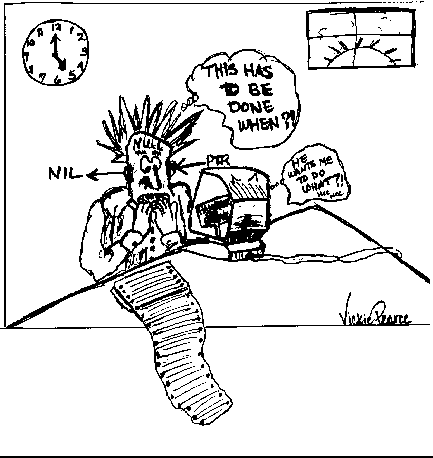
Cartoon
Vickie Pearce
Computer Science Department Faculty
319 Stright Hall
Dr. Gary Buterbaugh On Leave                          GLBUTER

Dr. John Cross                   Stright 338 357-4478 JACROSS

Mr. Thomas Cunningham            Stright 335 357-2463 TPC

Mr. Thomas Janicki               Stright 339 357-4491

Dr. Mary Micco                   Stright 332 357-2637 MICCO

Dr. Katherine McKelvey           Stright 305 357-7994

Dr. William Oblitey, chair       Stright 321 357-4491 OBLITEY

Ms. Therese O'Neil               Stright 332 357-6102

Dr. Charles Shubra               Stright 334 357-7917 CJSHUBRA

Dr. John Sweeney                 Stright 306 357-7995

Ms. Tia Watts                    Stright 305 357-4492 TIAWATTS

Mr. James Wolfe                  Stright 318 357-6104 JLWOLFE

Ms. Carol Miller                 Stright 319 357-2524 CAMILLER


FAX (412) 357-2724

Tompkins' Computer Lab Stright 107 357-6105

Don Rosenberger, Manager Stright 107 357-6100


E-mail:  usernames above are @grove.i up.edu