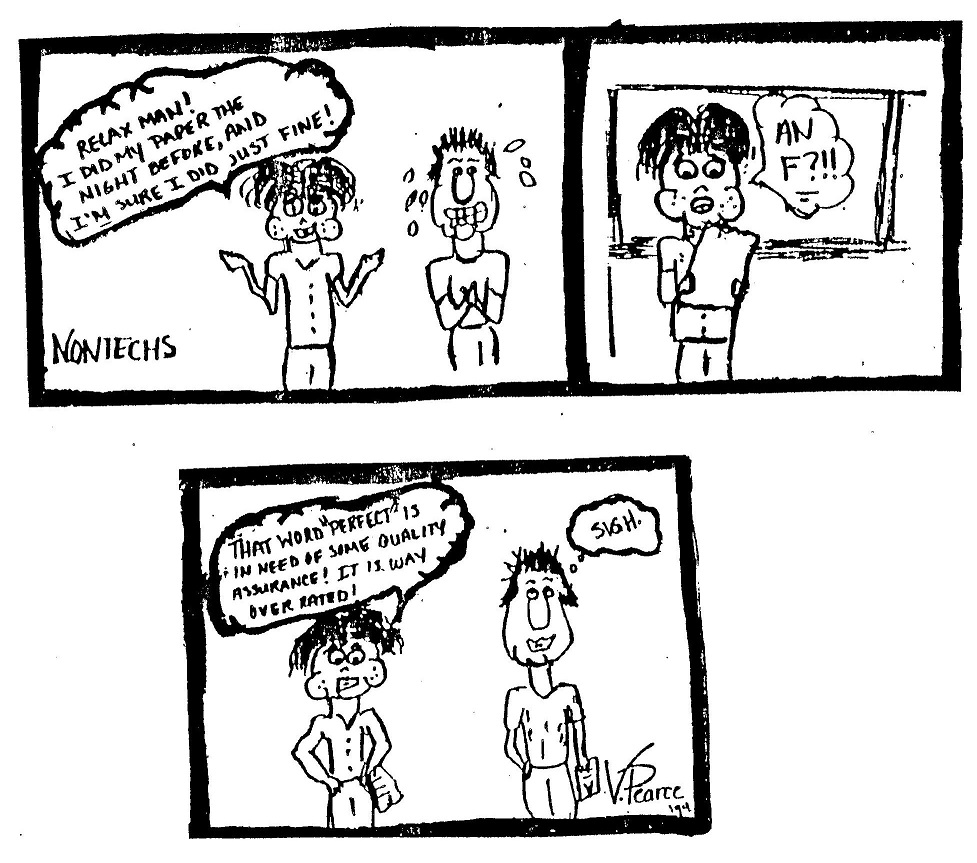
In one episode of Star Trek, after Dr. McCoy finds a miraculous treatment for an injured alien life form, he turns to Capt. Kirk and says, "By Golly Jim, sometimes I think I can even cure a rainy day." I get that feeling every now and then when things turn out much better that I could reasonably expect. Such is the case with this issue of The Debugger. At the beginning of April (my original submission deadline for this issue), I had very little with which to build a newsletter. But, amazingly in the last ten days many interesting things have come in; and all of them are in this issue, making this the largest issue ever.
There are FIVE student-written articles this time: two about internship experiences, one about a successful programming contest experience, one introducing the World Wide Web (this one even has references - I think this is a first for The Debugger), and a report on the Computer Science Club. The Comics page is also from a student.
In the standard features, Carol Miller reports that almost every one of the alumni have called, written, or visited recently (at least that is the impression you may get from her article). I don't know how she keeps all the details straight. Gary Buterbaugh asks for your help in providing some information; Don Rosenberger tells you about providing user documentation; Bill Creighton considers the problems of academic computing; and I give you my two cents about the curriculum.
I am also pleased to offer a reprint of an e-mail letter from Milford Hazlet. He gives a thoughtful collection of reminiscences about computer science at IUP in the early 1970's. I wasn't at IUP back then but I can appreciate his memories. Life seemed simpler when all it took to be regarded as a computer "guru" was the ability to make a drum control card for an IBM 029 card punch.
Jim Wolfe
Gary Buterbaugh
Most of those of you who read The Debugger are aware of the fact that in recent years the number of students in our department has declined. However, you may not be aware of the extent of that decline, the fact that this decline is nationwide, the fact that the decline in female students is particularly drastic, and what you can do about that. I would like to address those issues in my column.
Our program began with three or four students in 1973 and grew rapidly through the seventies and into the early eighties. In 1983, our enter class (freshmen and transfer students) was about 350 and the number of majors in that year was about 1150. Of that number, about half (maybe even a little bit more) were females and we probably had 30 to 40 foreign students.
Right now our number of majors is 150. Of these there are 11 foreign students, 18 female American students, and 121 male American students. The faculty have been fortunate that we have had a consistently high demand over the past several years for our Computer Literacy course so we have not lost any positions.
According to statistics published in a June 1991 issue of Information Week, in 1986 about 22,500 students received a BS in Computer Science and by 1990 that number had dropped to 5,300. Penn State reported a drop in the number of Computer Science graduates from 220 in 1984 to 80 in 1991. During the same period the number of graduates at Millersville in Math and Computer Science declined from 550 to 180. This trend was seen throughout the universities that make up Pennsylvania's State System of Higher Education. Although no statistics are available, conversations with faculty from these schools indicate they experienced the same sharp decline in female Computer Science majors that IUP did.
Our department has tried to do several things to begin to make this known and rectify the situation. We have sent out posters; through the development of a statewide organization, the Pennsylvania Coalition to Promote Computing, we helped develop a recruiting video; we have created a Educational Advisory Board composed of seven high school computer teachers and a school superintendent; and we have hosted high school days and programming contests. If you have suggestions on what we can further do, please let us know.
But what can you do? Well, I would like to ask all of you, both alumni and students, to consider helping us. The way I would like to suggest that you help us is to contact your high school or one in your area to ask them if you could come to talk to some computer classes about careers in the computing field. You should do a general type presentation, using, of course, IUP as an example. We have copies of overheads and an outline if you should decide to help.
On a personal note, I will be on sabbatical in the fall. I have decided that after a couple of rough years that I just need some R & R. I will be taking a trip around the world visiting Japan, Hong Kong, China, Bangkok, the Ukraine, Slovenia, Egypt, Tunisia, Nigeria, and several countries in Europe. I will be gone about 11 or 12 weeks. Must be nice, right? I'll let you know more about my plans in the summer.
Carol Miller
Are You Ready For Spring-
Last issue I made a nasty reference to winter being here in October. I feel like October was at least two years ago. Isn't Spring ever coming? This weekend the crocuses did come out though so I guess all is not lost.
It seems so different around here without Jim Maple. Quiet or something. I can't seem to put my finger on it. We really miss his smiling face while having coffee in the morning. But, he is certainly not missing us. He just got back from a long vacation to the Carolinas and Florida and sent us nasty cards about the weather up here. We didn't need that. But, we're adjusting to his absence.
Tia Watts is still on educational leave this semester. She plans to be back in the Fall with most of the work completed for her dissertation. I know she'll be glad when she finally gets her Ph.D. She has been working long and hard for it.
Gary Buterbaugh is going on sabbatical this Fall. As of now he is planning a trip around the world (in eighty days?).
By the time you get this, the banquet will be over; and I hope some of you came to join us. I know it isn't easy to get away through the week, but would some of you come if we held it on a Monday or Friday?
Carol (Butler) Galonis (12/87) stopped in over Spring Break while I was home recuperating from the first half of the semester so I didn't get to say "hello". Carol is working in the Information Systems area of Hechinger's in Landover, MD. I'm really sorry I missed you, Carol; but stop in next time you're around. I also send my sympathy on the death of your father.
Michael Gutzat (5/87) sent me an update and some really exciting news. Not only did he and Mary buy a house which they are moving into this month, but they are expecting a little Gutzat in April - not far off. Mike will be sending me the vital statistics when it arrives and I'll let you know. Hey, Mike, anytime now!
Speaking of new babies, we've had a couple more since you last heard from me:
Greg Scott (5/86) and his wife, Janet, had a little girl on December 9. Her name is Lauren Brooke, she weighed 7 lbs. 13 oz. and was 21 inches long. They sent me a picture and she is adorable! Congratulations Greg and Janet and thanks for the picture. Greg is still working at Merck and Company and was just promoted to Director of Information Technology Services. Congratulations, Greg, we knew you could do it.
And, speaking of the Scott's, Greg's brother, Tom, (12/93), was hired at PPG upon graduation. He was really excited, and we wish him well. Keep in touch, Tom.
Joanne (Stewart) Kuta and her husband, Dan, had a baby boy on November 4. He weighed 8 lbs and 4 oz. and was 18 inches long. His name is Patrick James and they call him PJ. PJ's older brother, Anthony, just loves him.
For those of you who don't know where Joanne is, she's working in the IUP ISC Center along with Bill Creighton, Rick Beck, Sam Puleio, Dan Yuhas, Bob Simon, John Carr, Glenn Good, Mark Strawcutter and anyone else I forgot. Also at IUP are Greg Foster and Ben Dadson.
We got a FAX one day from Cathy (Fleig) Gruss (5/85). Boy has she been busy! She is living in Long Island, New york and works as a Senior Programmer Analyst for Worldwide EDI Systems of General Instrument. She received her master's degree in Computer Science at Hofstra University, has been married for three years and is the mother of identical twin daughters named Miranda and Rebecca who were born February 13, 1993. Congratulations Cathy!! Thanks for sending the info.
Jimmie Joseph stopped in back in December. He brought me roses. They were beautiful and lasted for a long time. I enjoyed them over and over. Then, he came back up a couple days later to visit with Dr. Tompkins who was in town for Jim Maple's retirement dinner. Jimmie is also another busy person. He works for Allegheny Power Systems in Greensburg and is working on a double Ph.D. in Artificial Intelligence and Strategic Planning at Pitt. But, believe it or not, he took a semester off to attend the Pittsburgh School of Massage Therapy. Whew!! It makes me tired just thinking about it. It was great seeing you Jimmie. Don't be such a stranger.
Jimmy Maple (5/86) was here for his father's retirement dinner and for Christmas. I got a chance to visit with him and Vickie. They bought a new condominium in Virginia and have been busy adding decks, etc.
Willie Lewis (5/84) and Dave Wagner (12/84) both sent me email. I was so glad to hear from them. They are still the two soul mates they always were and following one another around the country. The last I had heard from either of them, they had gone from Honeywell in LA to do contracting work in England. Willie spent 2 years there and came back to Teradata in Los Angeles. Dave fell in love and got married (he met his wife in a restaurant in Windsor, across from the castle. Isn't that romantic?). They now have two children, a girl, Victoria Kathryn and a boy, Thomas Graham. After working a Teradata for a time, they both went to Cray Research in Minnesota. Oh, Willie is still single and he said if there is any nice girl out there who would like to support him, he's available. Notice I said "girl". I don't think there is more than one out there that might be willing. But, as I told them, they were students here when I started working for the department and they made me feel welcome and I've always felt something special for them for that. Thanks, guys.
And, speaking of England, Jane Cunningham (5/87) just got back from England. She was on business for Perot Systems. Welcome back, Jane!
Chad Dionis (5/93) called me one day and chatted a bit. Chad is working for E Systems in Virginia. He loves his job, he loves the area, and he just bought a new Toyota MR2, AND he loves it. Should we be surprised. Chad's home is not too far away, so you'd think he'd stop in occasionally. How about it, Chad?
I had email from Ron Olshavsky (5/87) who is in the DC area working for a company called Computech doing ORACLE, C, COBOL, and FORTRAN work for the government of Thailand. Sounds like really interesting work. Do you have to speak their language? Ron's wife, Leah (Sharpe) (5/87) is working as a programmer for AT&T. They just bought a house and are planning on staying in the area for a while. It was great to hear from you two; drop a line every once in awhile.
Brian Lawton (5/93) and Mindi were in town over President's Day. Brian is currently a Power Builder Client Server and is undergoing a two-year training program at Systems Automation to become a Power Builder engineer. Brian is really excited and is looking forward to getting out of the office some and working directly with clients. Mindi and Briana and I had lunch that day. Briana has really grown since I last saw her, and she's real excited about the coming event in her life. She is getting a new brother or sister the end of August. Although, Mindi told me she heard the baby's heartbeat the other day and said it sounded like a puppy dog, so I'm not sure what she might be expecting. But, regardless of what it is, congratulations Brian and Mindi (and Bri) on the coming event, and I know you'll keep me posted.
Janie (Pike) Kustaborder (5/92) is still at HRB Systems in St. College. She and Ron are working on remodeling their house in Tyrone. It sounds like a big undertaking, but I think they are having some fun doing it. I have to get up there and see it, and I will one of these days. Ron is now working at HRB Systems, too, which is really convenient for them. I'll be talking to you soon, Janie.
I heard through the grapevine that Brett Galura (8/93) is working for AES Corporation in the DC area. Let us know, Brett. Also, about your wedding plans.
Valerie Bonito (12/93) has been in touch. She is working for Premier Solutions in Wayne, PA which is a software vendor for banks. Hi Val, are you going to make it out this way anytime soon?
Jeff Michna (12/93) accepted an offer from AMS in DC, and after he got there they told him they were transferring him to Mississippi. He was not a happy camper, but they compromised and only sent him for a limited period of time and have made other concessions to make it more palatable. Jeff stopped in on President's Day to see us, too. We were really surprised!!
Bill Smith (12/93) is with Mellon in Pittsburgh and he had President's Day off, too and stopped by. He really likes his job and the Pittsburgh area. It was great to see you, Bill. Stop in again.
Tonya Jeschonek (5/92) called me recently. Tonya is still at Shared Medical in Philadelphia and loves her work. She is traveling and working with customers for awhile and still ice skating and working in the gym. I think she might sleep every once in awhile, but I'm not sure. Keep in touch!!
Cathy Lawrence (8/93) got a job with Fisher Scientific in their Technical Support area. I haven't heard from Cathy since she started, but I hope she is enjoying her work.
Mark Lacy (5/89) is working in Rockville MD or at least he was in the Fall. Where are you now, Mark? Jen Baldwin asked me if I'd heard from you, so you might want to drop her a line. I can give you her address. Let me know what's up!
Jim Barrett (5/80) called to let me know there are job openings at Compaq in Houston. Jim works in the Server Division of Compaq and seems to really enjoy what he's doing. I don't know if I ever mentioned that Jim is from this area and came in and did a colloquium for us. It was really nice and everyone enjoyed it. Thanks Jim.
Steve Cole was around over the holidays when no one was here to say "hi". Steve is with Datatel working on installation services where he installs software and hardware at client sites in the DC area. It was really nice to hear from you, Steve.
WOW!!! We got this great big long email message from Milford Hazlet who graduated in 1975 and he gave a really nice rundown on equipment, etc. back then!!!! It was neat. Thanks, Milford, for sending it. Milford, it was really interesting having your look back into the past.
Milford brought up an interesting point, however, so I'm going to throw it out to you to take it and run with it. He wondered why there is never very much in my column about pre-80's graduates. I think it has something to do with you pre-80's not knowing me. I'm actually a fairly nice person (depending on who you talk with), but at any rate, I haven't bitten recently and I have had my shots. But, I think other pre-80's grads would probably like to hear about some of their classmates, so please get in touch with me and let me know where you are, how you are doing and what you are doing.
Adam Beck (5/92) got engaged over Christmas. He and Lisa have been dating since college. They are planning the wedding for summer and it's going to be in Indiana. Congratulations Adam and Lisa!!
John Campus (8/91) stopped in one day last Fall. John just changed jobs from Pittsburgh to a job with the DER in Harrisburg. He is a computer systems analyst I. He brought pictures of his son, Andrew, who just turned two. He looks just like his father, and he is the apple of his father's eye, isn't he, John? I'm really glad you stopped in. It was so nice to see you.
Barry Craig (12/85) called me the other day. He is working for New Enterprise Stone and Lime Co. in New Enterprise, PA. He was giving a recuitment-type speech at a high school and needed some statistics for it. Let me know how it went, Barry.
Little Tidbits I've heard from others:
Roger Hughes (12/93) is working for Westinghouse in Pittsburgh.
Edwardo Morales (5/91) is planning on attending graduate school at NJIT where he is working.
Lois Edinger (12/93) accepted an offer from Shared Medical and is also busily planning her wedding. Good luck, Lois.
Jamie Zettlemoyer is also at Shared Medical.
I've heard either from or about a few other December jobs:
Ryan Anderson left for Colorado to job hunt (I want everyone to hear this: I heard about a job I thought Ryan might be interested in, I called his parents' place and told them. They said they'd have him call me. He called me from the CAYMAN ISLANDS to tell me he was going to Colorado. I didn't want to hear it.)
Lisa Dillon is working at Diamond Drugs here in Indiana. I had lunch with her the other day.
Dave Edmunds is working at Mellon, as are Eric Hohman and Jim Stevenson.
That's all the news I have room for this issue. Please keep in touch and send me your latest. THINK SPRING!!
Don Rosenberger
I am sure that some of you are getting tired of the same old status reports on Tompkins Lab. (I certainly am.) Therefore, I decided to tell you about our latest accomplishment from the lab staff.
Recently, we were able to publish beginners' manuals for some of our systems. The manual for VAX/VMS included some hints on how to use Kermit from dorm/home most effectively, and certain points everyone should know about their own LOGIN.COM file. We have also released manuals for beginners on the Macintosh PC and the NeXT workstation. The VAX Debugger now has a lab manual, and so does the VI (UNIX) editor.
Since the emphasis in Tompkins Lab is to support upper-level CO courses, we had not addressed documentation for neophytes as our own responsibility. However, over time I became concerned that documentation did not seem to exist for students/faculty/staff who were new to a system. (I believe the politically correct term for these individuals in the Clinton era is "the computer-literacy-challenged".)
One of my goals became to find a way to develop some of the documentation which seemed to be so desperately needed by the IUP community, without impacting our support for the courses which use the lab's primary users. Part of the answer came from the department's requirements for graduation. All Computer Science majors must take EN322 - Technical Writing. I learned that some of the students were having difficulty finding a major project to write about. Therefore, I agreed to sponsor some of the writing projects, and our documentation efforts began.
I decided that most of my editing efforts would be over the weekends, on my own time. This minimized the impact of the documentation upon course support. Where I found that the effort required for a manual exceeded a semester - I required the student to write a very good draft. Such drafts are then turned over to members of the lab staff for "buffing". Where possible, we would give a copy or two of each manual to students and/or IUP staff for review and feedback. This has helped us to answer most of the questions that typical users would seek assistance with.
Our manuals are released via two companies named Copies Now and Pro-Packet. We use the companies so that we can share the documentation with the IUP community without impacting our own departmental budget for paper, copying, etc. The documents are stored under my name, and also under "Tompkins Lab". So far, all of our documents have been under $3 per copy. Students can go to one of the companies, request the document of their choice, and it will be copied for them while they wait. If students are not sure whether a manual will be helpful, they can come to Tompkins Lab. We will loan a copy of a manual in exchange for an I-card. In this way, students can determine if a manual is useful to them before they purchase it.
New manuals underway this semester include beginners' manuals for minitab, Internet, and VAX E-mail. I am hopeful that our faculty will also use the students in EN322 to develop handouts and manuals for our upper-level courses. The sophistication of these courses makes it difficult for me to determine the amounts of information required by most students.
As always, the lab staff and I are striving to provide the best support possible to our curriculum. If you find yourself in the neighborhood, please drop in.
Ron Howe, President
Greetings from the Computer Science Club. As the president, I have tried to get the Club rolling on some interesting demos, presentations, etc. At our first meeting in the year 1994, Dr. Shubra gave a demonstration on the aspects of MS Access , i.e. how it works and how it is used today.
At another meeting, the Club secretary, Ken Arthurs, and a worker from Tompkins Lab, Tony Lonsinger, brought in their PC's and demonstrated some exotic art, music, and graphics, and they also delved into multimedia and some impressive games.
As a publicity stint for Club, we organized a disk sale. We sold high density, pre-formatted disks for 50 cents a piece. The turn out was terrific and it seemed everybody was happy with that public service.
Ethan Sorkin, the club PR man, demonstrated Mosaic, and the hypertext World Wide Web, at Stapleton Library. A lot was learned at that meeting.
Hopefully, in the fall of 1994, the Club will be touring a railroad tracking facility in Pittsburgh. I will be doing my best to keep the club moving in a positive direction.
Providing Computing Support with Limited Resources
Bill Creighton, ISCC
As Director of Academic Computing Services at IUP, I am very much concerned about what constitutes an appropriate level of service and which services should be provided. The priorities that individual members of the IUP community believe should be set for service providers are prejudiced by personal perceptions. Individuals seldom consider the global needs of the overall community. The institution should take a positive role and look out for the good of the academic computing user community as a whole.
Forward thinking and aggressive faculty must be afforded a level of institutional support that will encourage them to keep current with the advancing technologies. At the same time, individuals who have approached technology in a more cautious and deliberate manner must be accommodated with just as much care and concern. A delicate balance must be maintained that carefully considers all forms of technologies that are either in use by the academic community now, or will soon be in use by members of that community. Support for these technologies must be an integral part of all plans for their use.
The use of all technologies must be coordinated and well focused. Providing a proper level of institutional support for academic uses of technology will require that planning take into consideration more than the technologies that are able to be demonstrated today. Institutional planning must also consider support that emerging and future technologies will require.
Support personnel who are aware of computing and who are also able to respond appropriately to users provide the link between meaningful institutional use of computing and the user community. Computing has become a mainstay of our society, and its importance within institutions of higher education cannot be overstated. The specialists who maintain expertise about the various forms of computing and the manner by which individual users can use computing to accomplish goals and interact with other forms of technology are of great value to their
institutions. They support the efforts of each technological constituency by nurturing an institutional awareness of the diverse technologies available to members of that user community.
IUP is blessed with quality computing support personnel not just in Academic Computing Services but throughout the
Information Systems and Communications Center. A major concern however is that there are too few personnel to provide the levels of support that are needed. We have experienced a rapid growth in both the number of computing units and the number of computing users in recent years. Unfortunately that growth occurred during a period of austerity at IUP and the issue of support personnel that is crucial to the effective use of the equipment has not been properly addressed. It is time for us to address the support issue. We cannot continue to increase our institutional use of technology without also recognizing the need for user support that goes hand-in-hand with that technology.
Success at Programming Contest
Mark Rogaski
I first heard about the PACISE (PA Association of Computer Information Science Educators) Programming competition before an exam in Mr. Cunningham's Data Structures class. The next day, Ethan Sorkin and I went down to Mr. Wolfe's office to find out if we could participate. Mr. Wolfe gave us the a summary of the rules: We would have 3 hours to work on 6 problems. All solutions had to be coded in Turbo Pascal or C. We could use any references manuals or text books -- but program listings and source code were forbidden. And we could ask only for clarification of the stated problems from the judges. We had about 3 weeks to practice for the competition, due to the fact that those of us who were interested had not found out about it when the first announcements were made.
The team that showed up for the first practice session consisted of Bob Durbin, Aston Au Yeung, Ethan, and me. We received 3 sample problems and were given an hour and a half to work on them. After the time allotted, we discussed the algorithms we had used on the problems, and which algorithms may have been quicker to implement. The same format was used for the second practice session. For the third session, however, we discussed strategies that could be used to tackle most problems. Due to the fact that we were trying to get a correct solution in as little time as possible, we discussed strategies that would take as little code as possible.
The competition was part of the PACISE conference at Slippery Rock University; but the hotel was in Butler. That made for a bit of driving during the weekend. A problem of figuring out which one of us would sit out as an alternate (programming teams have three members) was eliminated when Bob told us that he couldn't go due to a flooded basement.
To open the conference, we listened to a dinner lecture about Genetic Algorithms which was a wee bit dry for a dinner lecture; but the subject was very interesting. Then we proceeded to the SRU campus to work on two test problems and get used to the setup of the computer lab in which the competition would be held.
The next morning, we had breakfast at the hotel (which made me think twice about ever eating eggs again :)) and headed off for the competition. A few final details were mentioned, and we went to it. Out of the 6 problems we had, we finished 3. The first problem was the Tower of Hanoi problem, which we finished immediately. (Thank you, Mr. Cunningham for using it as an example in class!). The biggest obstacle seemed to be the fact that we were only given one machine for 3 people to use. This became quite frustrating in the last 45 minutes when all three of us had to debug different solutions. The biggest problem we faced was those dealing with who gets how much time on the computer.
At lunch the winners were announced. Out of 19 teams, we took third place. A team from Edinboro came in first, and a team from Shippensburg took second. And we actually won something, two Borland Turbo C++ packages (why they gave two prizes to a 3-person team, the world may never know).
The competition was something that I would enjoy doing again. And it may be easier next year because I hear that they are probably having the conference and competition at IUP.
Milford Hazlet, Class of '75
Hello Everyone!
I always look forward to reading the latest Debugger. I am from the class of '75 ... That's 75BC (Before Carol)!
I am not sure if I have ever met Carol; I visited IUP once in late 80's when I was finalizing my donation to the Alumni efforts to restore the old mansion; and I stopped in that summer to see the "new" computer science building; it was built after I left. It may have been then that I was been introduced to Carol; my apologies if I don't remember you. I do know about you from The Debugger - when you finally got your degree. You know Carol, your efforts to keep everyone up to date on the Alumni is invaluable. It's probably the most read section of The Debugger; keep up the good work. It's too bad that we never hear much about pre-80's grads; perhaps it's all part of the "BC" syndrome. Anyway, "Hello!".
I just had to send a note up to Mr. Maple, wishing him well in his retirement. I can't believe its been 20 yrs since the 1973 Computer Science classes in Weyandt Hall. I graduated in '75, number 3 in a class of 3 double majors (Math & CS). I often wonder what ever happened to the other two. One was Jim "Hoppy" Himmelreich. I believe we were the 2nd Computer Science graduation. I seem to remember that Jimmy Stewart spoke at our commencement; but the OAK yearbook shows Peter Jennings, if that rings any bells.
CO110 was programming with PL/I on the 360, because that was the only language that was common to both "online" and "batch". FORTRAN was a separate class then. We used to "live" in the basement of Sutton Hall, sitting in front of those keypunches, if you were lucky, you got the 039 model, the one with memory. I remember how "smart" we looked when we figured out how to "multipunch" block letters on the cards to spell our names. I used to use them for book marks! I remember when we got our first "glass-tty", a CRT hooked up in Weyandt ... That's when the Xerox replaced the IBM system, and Sutton Hall got Teletype's. So the next game in town was trying to figure out how to type block letters on the paper tapes!
Also, do you remember these infamous words that would pop up right in the middle of a project: "Recovery says Please Stand by" !!
Do you remember the "Granny Gobbler"?? Back then the Sigma allocated disk storage in granules; and for some strange reason, every now and then, your allocation would disappear, to someone else's account...
I remember when Ray Misicka (spelling?) put Star Trek on the Sigma, I think I still have some of those scrolls of tty paper that recorded for all history my conquests over the Klingons!
I remember one day, the Microdata got sick, and Dr. Tompkins had every board pulled out, scattered around all over the desks, examining each circuit in an attempt to restore its health.
I also remember the day a very popular Indian professor left the department; it left many of the upper classmen distressed. I must say, he left before I had the opportunity to attend one of his classes.
I remember when the Physics department got the old RCA 110A 8 bit serial computer from NASA; and I wrote a translator on the Sigma to punch program tapes for the RCA. I taught the RCA how to play the "Entertainer"; it was an instant hit. I remember when we installed the first RJE to the Sigma in Weyandt, and then one for the business majors.
I think the most memorable summer of my life, was the summer of '74. Back then summer was divided into 3 semesters; I think every CS class I took, Mr. Maple taught. I remember having to write the "Divide" instruction for the Microdata, in our micro programming class, and having fallen ill with strep throat during finals week. Thank goodness for my partner, Tom "Tommo" Slezak, who was able to present our final product to Mr. Maple.
I remember very many good times, but also there were hard times; and most of all I remember how Gary was there, like a rock, to support me while I struggled to keep on my feet. After a decade of reflection, I can truly say that Mr. Buterbaugh, Mr. Maple, Dr. Tompkins, and the new guy on the block, Mr. Shubra, took the time to know me as a person, as well as a student. The importance of that can not be under stated. So, gentlemen, I tip my hat, and offer you a very grateful Thank You!
Finally, I remember with much mixed feelings, graduation day. It was wonderful to have finally achieved recognition for the years of effort. But at the same time, it was an emotional strain to leave everyone and the whole University culture, that only IUP could have created, behind. Still, to this day, when I read The Debugger, I re-live all those mixed emotions again. It was truly a time when I not only learned my bookwork, but learned about life; and that folks, is growth; and you were all part of it.
I wish for all the faculty to be able sit in the glow of such fond memories, that they will bring you happiness and well being for years to come.
It is difficult to close this, so I'll just say "au revoir", and hope that some day we'll be able to relive our memories together, and catch up on all that has happened in between.
Bo Gohn
I have been on my internship for approximately 4 months. In that time have, I have seen a change in myself and the "hats" that I wear.
When you get out into the "real world," I think you as a person change. I have seen that in myself. You learn the basic necessity for maturity and professionalism. When your in college, it's possible to slack off and still do a half decent job in most courses, but it has been my experience that if you slack off even for a day in business it could set you back for a week.
I feel fortunate that I have been given an opportunity for a lot of responsibility. This definitely promotes time management and prioritization skills. I think that interns should have the opportunity for a high level of responsibility. I stress opportunity, because I don't think it should be given if the individual is not ready.
As far as the wearing of "hats", I have many. I am extremely happy in what I have gotten into where I am currently doing my internship. Basically what it comes down to is wherever information is being transferred in the corporation, I am there. I work in networking both PC, PowerPC, MACs and Mid range VAX computer systems. I am working in Desktop Publishing. I develop front-ends in Paradox, Fox-Pro and Visual Basic. The backends are Interbase on a SCO-UNIX, and application driven databases in a client-server atmosphere. I also currently engaged in business process re-engineering of the corporation which involves 4GL's and CASE tools. Also, I have had the opportunity to meet with clients of the corporation and discuss CD-ROM and multimedia. This is helping my communications skills.
Basically, I am gaining a wide understanding of computing and information systems. So, my "hats" are: developer, analyst, network administrator, maintenance, and DBA. I don't think anybody could ask for any wider a range of fields.
I have found out that Computer Science is not all about sitting at a terminal for 14 hours and coding. Its about how information travels and we can better facilitate and efficiently carry that information in a timely and meaningful format. Its about Computer Scientists understanding an end-users query and providing a feasible and correct solution not drawing hundreds of flowcharts and writing programs to solve puzzles. However, these things are necessary in terms of concepts that you realize once you get out into the real world.
My advice to any Computer Science major is this: no matter how tough you THINK it gets, NEVER give up because its a lot tougher out here if you do give up and the rewards are boundless if you don't. Also learn on your own time, be familiar with new concepts like OOP, RCD, BLoBs, and Plug and Play. It makes you a more marketable person when you get here.
Rebecca Salter
Hello Computer Science Faculty, Students and Alumni. Here is an update from the world of an intern, who is working at PHICO.
Things are going great. I am learning a lot about the AS/400 system and about how an insurance company works. I work with the claims and actuarial systems, programming in COBOL to create reports. I have also used CL, an IBM command language, to call the COBOL programs that run the reports.
Everyone here is friendly and willing to help me. They understand the problems I am having, since they all had new things to learn themselves. I have also met some IUP graduates, who went through the internship program. They have helped me to realize how important an internship is.
The experience I have gained by doing this internship cannot be replaced by an independent study or by classes alone, and in today's society I know I will need experience in the business world to get a job in this field.
Jim Wolfe
This past year I have been chair of the Department Curriculum Committee. This year, as in many past years, the committee has been wrestling with the problem of how update the Computer Science programs (including new, hot topics like object-oriented programming, graphics user interfaces, client-server concepts, and many others), while at the same time maintaining overall control of the curriculum so that the courses still "fit together."
To say that the task is going slowly is a vast understatement. In fact, if one were to list the top 10 slowest changing things at IUP, it might have these elements.
10. Locations of snails in the Oak
Grove
9. Inverse of Ackermann's function
(there's a challenge for you)
. . .
5. Locations of dead snails in the
Oak Grove
. . .
3. Any opinion held by a Computer
Science faculty member
2. Number of rainy days at IUP
1. The curriculum
There are many reasons for the slowness in changing the curriculum.
The administrative structure for modifying a curriculum is cumbersome. Even very small changes (dropping a prerequisite, changing a course title, changing a catalog description) must pass an approval gauntlet - the Department Curriculum Committee, the Department faculty, the College Curriculum Committee, and the Senate Curriculum Committee. More elaborate changes (revising the syllabus, adding or dropping a course, changing the minor requirement) must additionally be approved by APSCUF, the IUP Board of Trustees, and sometimes even the State Board of Education. Even if there were unanimous agreement by everyone of these bodies that a change should be adopted, it can take one or two years just to bring the issue before each committee. Also, the chance that any suggested change would pass all of these committees unscathed is practically zero.
Our faculty are full of opinions - many of which are in conflict. Consider an example. Last fall, the Department Curriculum Committee indicated that it was considering a change of languages in CO 110 (from FORTRAN to Pascal). Computer Science faculty opinions ranged from definite support to equally definite opposition with many opinions falling in between. A survey was also conducted of the faculty in other departments whose students take CO 110. It asked whether or not these departments would favor a change from FORTRAN to Pascal. The results showed about 1/3 favored the change, 1/3 opposed the change, and 1/3 did not care or were willing to leave the decision up to the Computer Science department. What will happen? Almost certainly, the language used in CO 110 will remain unchanged.
As a second example, consider what may happen when the department does come to agreement. Last year, the department approved changing the foreign language requirement (something many of you probably have fond memories of). The change would allow a student to take "an appropriate linguistics course" as an alternative to the last semester of the foreign language. Although no such linguistics course currently exists at IUP (and we acknowledged that in the proposal), we felt that making our language requirement more flexible would create sufficient demand for the English department to develop such a course. The English department had someone who was interested and would propose the linguistics course as soon as demand was evident. The College Curriculum Committee rejected the proposed change in foreign language requirement, claiming that we could not make a requirement involving a non-existent course. When we pointed out that linguistics was optional - students could still meet the requirement by taking the foreign language. We also pointed out that the English department could not get a linguistics course approved without some source of student demand. The college committee suggested that our foreign language requirement change and the linguistics course be proposed concurrently. That is, their solution to this chicken-and-egg problem was to make both happen first.
From outside the department (and outside of IUP), there are other organizations suggesting ways to improve the Computer Science curriculum. There is a Corporate Advisory Board of local industry representatives which meets twice a year and tries to suggest curriculum changes that would make IUP Computer Science graduates more marketable, more useful to industry, more likely to find a job. Because computer science at IUP has always been application oriented, what industry is asking for has always concerned us. This board has suggested including more emphasis on specific software engineering tools, GUIs, databases, and Unix while maintaining the basics in FORTRAN and COBOL. Some of these topics have led to the Department Curriculum Committee considering revamping CO 315 (Large File Organization) and CO 441 (Database).
From conferences that the faculty attend, we get ideas of what is being taught at other universities around the country. I recently attended the ACM SIGCSE (Special Interest Group on Computer Science Education) Symposium. There was a great amount of talk there about the object-oriented paradigm. There were many speakers who were advocating the introduction of object-oriented programming, some even suggesting that C++ and object-oriented concepts should be the principal focus of the first computer science course. There were an equally large number of speakers who advocated the introduction of GUI programming and hypermedia management. Some of these topics have led to the Department Curriculum Committee considering revamping CO 310 (Data Structures) to focus on object-oriented programming.
The SIGCSE Symposium also contained one unusual curriculum-related event. The keynote speaker, Norman Gibbs of the Software Engineering Institute, gave a distinctly applications-oriented presentation. Dr. Gibbs very much reflects the current views of industry and much of what he said was along the lines of what our Corporate Advisory Board is telling us - emphasis on software engineering, communications, tools, etc. In essence, his talk indicated that at IUP our emphasis on applications should continue to pay off in terms of placing our students because we are doing what industry wants. I had to smile as I heard Dr. Gibbs talk because I looked around me and saw that many of the hundreds of other SIGCSE attendees were absolute aghast. They are primarily advocates of the "pure" computer science curriculum as outlined by ACM which gives little consideration to the marketability of a graduate.
Finally, let me give you my opinion on where things stand with the various proposed curriculum changes. There is consensus agreement within the Computer Science faculty on what should be added to our curriculum. However, there is general disagreement on how and to what degree the new material should be added. And, there is heated disagreement on what should be left out to make room for the new topics. Having spent many years on the Department Curriculum Committee, I would sum up this situation with one word - normal.
The World Wide Web: A Gentle Introduction
Ethan R. Sorkin, Junior
The Internet has seen a geometric increase in usage over the past few years that has no end in sight. With this increasing size has come increasing complexity and vastness of information resources. The Internet has also seen a vast increase in media exposure and a large number of books written about it. The electronic outgrowth of this complexity has been the development and adoption of tools to index, search, and retrieve the resources that are available on the Internet. Some of these tools are archie, WAIS (Wide Area Information Search), gopher, and the World Wide Web (WWW).
The World Wide Web is a distributed network of hypermedia documents on the Internet. "The official description describes the WWW as a 'wide-area hypermedia information retrieval initiative aimed to give universal access to a large universe of documents'"(Hughes). This initiative was started at CERN (the European research facility for particle physics) in 1989 by Tim Berners-Lee. The WWW has grown enormously since its beginnings; Web traffic at the CERN web server has grown at twice the rate of the Internet itself since it first went online. In 1993 alone, the "rate of growth for WWW traffic was 341,643%"(Treese). The Web is transmitted over the Internet via HyperText Transmission Protocol (HTTP), a client/server protocol for TCP/IP.
Hypermedia is an extension of hypertext, a computer interface to text which allows cross-references to be followed, that includes images, video, sound, and information gateways (Torkington). These cross-references are referred to as links or hyperlinks. The WWW has been implemented by several clients and servers on almost all major software platforms. Documents on the WWW are written in HyperText Markup Language (HTML), a language based upon, but not a sub-set of the Standard Generalized Markup Language (SGML). Hypermedia objects and resources on the Web are referred to by Uniform Resource Locators (URL's) which are currently defined by a work-in-progress (Berners-Lee).
What makes the Web so useful is that all the information on it is searchable and indexable by keywords and/or subject. As a result its hypertext nature, the results of a search are often in hypertext themselves and searchable too. The large reason behind this growth and usefulness is the ability of the web to use information from the following resources:
anything served through gopher
anything served through WAIS
anything on an FTP site
anything on Usenet
anything accessible through telnet
anything in hytelnet
anything hyper-g
anything in techinfo
anything in texinfo
anything in the form of man pages
sundry hypertext documents
Works Cited
1. "Entering the World-Wide Web: A Guide to Cyberspace." Kevin Hughes. September 1993.
2. "The Internet Index." Win Treese. January 1994.
3. "Uniform Resource Locators Internet Working Draft (work in progress)." URI Working Group of the Internet Engineering Task Force. Editor, Tim Berners-Lee. March 1994.
4. "WWW Primer." Nathan Torkington. December 1993.
5. "comp.infosystems.www FAQ. Thomas Boutell. March 1994.
As Gary Buterbaugh mentioned in his article, he will be on sabbatical during the fall term. Bill Oblitey has been elected interim department chair for that semester. Bill will also be taking over the internship supervision task and the teaching of the seminar courses.
The internship presentations for students doing their internship during the Fall/Summer period (roughly January through July) will be given on Friday, July 15, 1994 on the second and/or third floor of Stright Hall. Anyone interested is invited to attend.
You can become a charter member of the IUP Computer Science Department's Century Club. Membership in the Century Club is obtained by pledging at least $100 through the Foundation for IUP for the Computer Science Department. Century Club members will receive a gift (tee shirt, mug, glass, etc.) for their membership each year.
A pledge of $100 is less than $10 per month. Please consider this opportunity. To join cut off the form in the next column, complete it and commit yourself to giving $100 for 1994.
The Computer Science Department has recently been given permission to give alumni access to the university's mainframe DEC VAX computer. A Computer Science Alumni Account (D180) has been established. Alumni who wish to be added to this account need to send or fax the information below to us (our fax number is 412-357-2724). We will then send you an account card (once it is processed) and directions for use of the account. There is no charge to you for use of this account.
Name: ____________________________________________________________________
Social Security Number: ___________________________________________________
Home Address: ________________________________________________________
________________________________________________________
Work Address: ________________________________________________________
________________________________________________________
Home Phone: _____________________ Work Phone: _________________________
Signature ______________________________________ Date __________________